ANT PC | 02-03-2026 14:25:18

Artificial Intelligence has moved beyond experimentation into real-world deployment across industries such as healthcare, finance, manufacturing, research, and autonomous systems. At the center of this transformation lies specialized computing infrastructure designed to process vast datasets and complex models efficiently. An AI Server is purpose-built to handle these intensive workloads, providing the computational foundation required for training, inference, and large-scale AI operations.
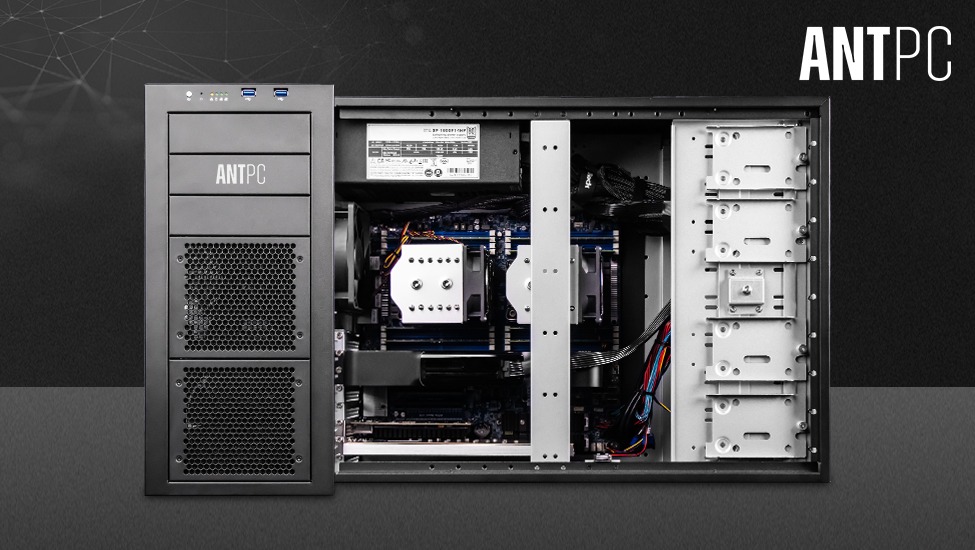
An AI Server is a high-performance computing system optimized for artificial intelligence workloads. Unlike conventional servers, it integrates advanced processors, high-speed memory, accelerated storage, and—most importantly—powerful GPUs. These systems are designed to handle parallel computations required for deep learning, neural networks, and data-intensive analytics.
Modern AI servers are deployed in data centers, research labs, enterprises, and cloud environments where reliability, scalability, and sustained performance are critical.
A GPU Server for AI plays a central role in accelerating machine learning and deep learning tasks. GPUs are designed with thousands of cores that can perform parallel operations, making them significantly faster than CPUs for matrix computations and neural network training.
An AI server GPU configuration enables faster model training, reduced time-to-insight, and improved efficiency when handling large datasets. This makes GPU-based servers essential for applications such as:
Deep learning model training
Natural language processing (NLP)
Computer vision and image recognition
Recommendation systems
Large-scale data analytics
As AI models grow in size and complexity, the demand for multi-GPU and high-density GPU server architectures continues to increase.
A well-designed AI Server balances multiple hardware components to ensure optimal performance and stability:
GPUs are the core of AI acceleration. Enterprise-grade GPUs are optimized for continuous workloads, high memory bandwidth, and large VRAM capacity, enabling efficient processing of massive AI models.
While GPUs handle parallel computation, CPUs manage data preprocessing, orchestration, and system control. AI servers typically use multi-core processors to avoid bottlenecks.
AI workloads require large system memory (RAM) for dataset handling and fast NVMe or SSD storage for quick data access. Storage performance directly impacts training speed and inference latency.
High-speed networking allows AI servers to scale across clusters, supporting distributed training and multi-node deployments. This is essential for enterprise and research environments.
AI server GPU systems consume significant power and generate heat. Efficient cooling and power delivery ensure consistent performance and long-term reliability.
AI servers are used in a wide range of applications, including:
Healthcare: Medical imaging analysis, diagnostics, and genomics
Finance: Fraud detection, algorithmic trading, and risk modeling
Manufacturing: Predictive maintenance and quality inspection
Research and Academia: Scientific simulations and AI research
Autonomous Systems: Robotics, self-driving vehicles, and smart surveillance
Each use case has different workload characteristics, which is why AI server configurations often vary based on performance, memory, and GPU requirements.
Organizations deploy AI servers either on-premise or within data centers depending on operational needs. On-premise AI servers offer data control and low latency, while data-center-based deployments provide scalability and centralized management.
In both scenarios, hardware reliability and workload-specific optimization remain key considerations.
Not all AI workloads are the same. Training large language models differs significantly from real-time inference or data analytics. A properly designed AI Server aligns hardware selection with workload requirements to maximize efficiency and reduce operational overhead.
System integrators and solution providers, including organizations like ANT PC, focus on aligning AI server GPU configurations with real-world compute demands rather than generic specifications.
AI servers form the foundation of modern artificial intelligence ecosystems. With the growing adoption of deep learning and data-driven decision-making, the importance of scalable, reliable, and GPU-accelerated infrastructure continues to rise. A well-architected GPU Server for AI enables organizations to innovate faster, process data more efficiently, and deploy AI solutions with confidence.
As AI workloads evolve, so will AI server architectures—making informed infrastructure planning a critical step for any organization investing in artificial intelligence.
Read More Blogs:-
Ultimate Guide to AI Workstations
How to Build a Future-Proof Gaming PC

Find the perfect setup to accelerate innovation in AI and computing.

Our agents and experts are always looking forward to assist you. If you wish to communicate something or facing any issue, please call on our helpline number.
.png)