ANT PC | 21-08-2026 12:27:35

The local AI workstation market has shifted from a niche sandbox for experimental developers into a mission-critical battleground for enterprise deployment. For teams looking to run massive Large Language Models (LLMs) locally, train specialized domain weights, or run real-time inference without cloud latency, selecting the right hardware architecture is the single most important decision of the fiscal year.
A common misconception in the developer community is that all high-tier AI workstations are created equal. Specifically, when comparing the market's four most talked-about platforms—the AMD Ryzen AI Halo, NVIDIA DGX Spark, ASUS Ascent GX10, and MSI EdgeXpert—many assume they share a unified underlying architecture.
They do not. This technical analysis breaks down the massive structural divide between these platforms, dissects their performance metrics, and evaluates which system delivers the absolute best return on investment (ROI) for price versus performance.
To evaluate these systems properly, we must first divide them into their true hardware families: the unified NVIDIA ARM ecosystem and the standalone AMD x86 architecture.
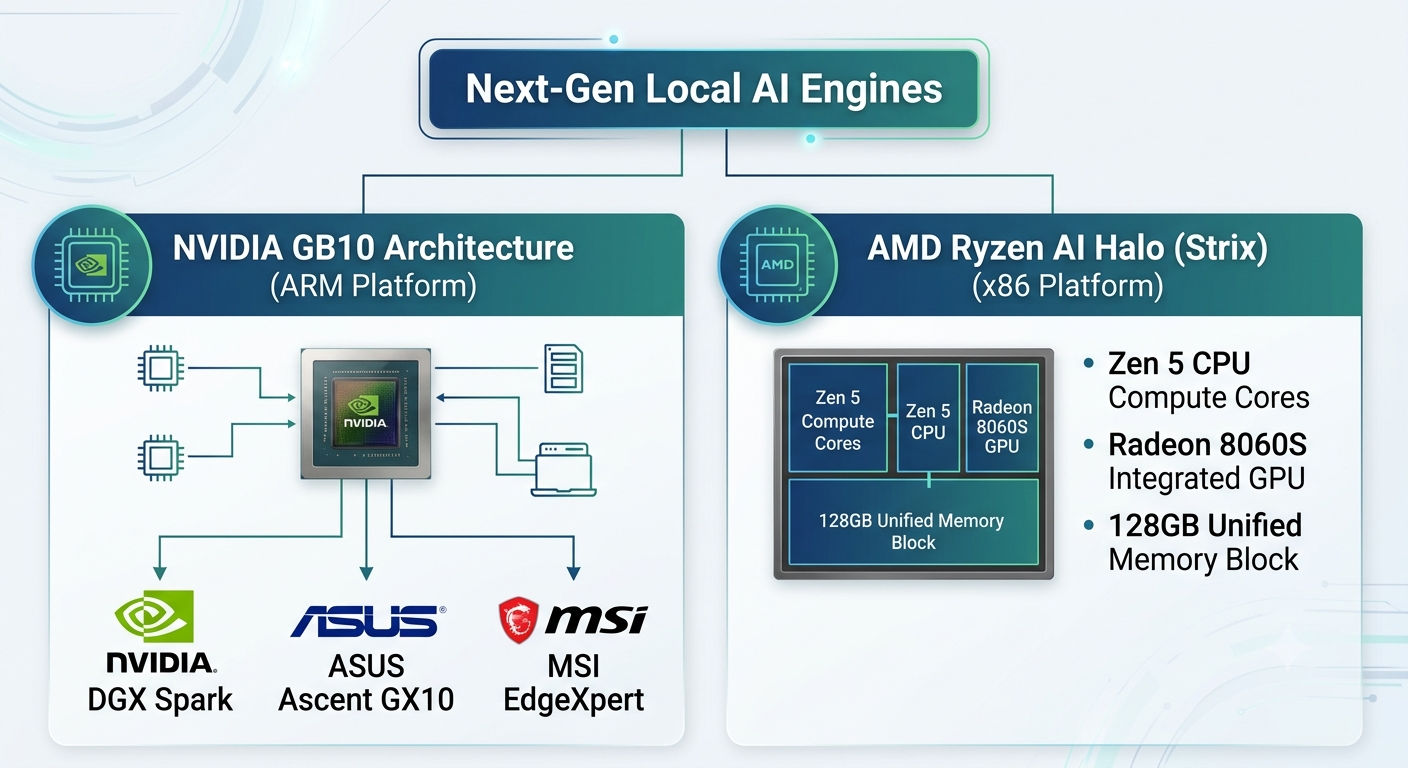
These three machines are fundamentally built on the exact same blueprint: the NVIDIA Grace Blackwell GB10 Superchip platform.
The AMD Ryzen AI Halo (built on the highly anticipated Strix Halo / Ryzen AI Max+ platform) takes a fundamentally different path.
| System Feature | AMD Ryzen AI Halo | NVIDIA DGX Spark | ASUS Ascent GX10 | MSI EdgeXpert |
| CPU Architecture | x86 (Zen 5) | ARM (20-Core Grace) | ARM (20-Core Grace) | ARM (20-Core Grace) |
| GPU Architecture | Radeon 8060S | Blackwell GB10 | Blackwell GB10 | Blackwell GB10 |
| Unified Memory | 128GB LPDDR5x | 128GB LPDDR5x | 128GB LPDDR5x | 128GB LPDDR5x |
| Memory Bandwidth | 256 GB/s | 273 GB/s | 273 GB/s | 273 GB/s |
| Peak AI Compute | ~60 TFLOPS (FP16) | 1,000 TFLOPS (FP4) | 1,000 TFLOPS (FP4) | 1,000 TFLOPS (FP4) |
| Operating System | Windows / Linux | DGX OS (Linux) | Enterprise Linux | Enterprise Linux |
| Estimated Market Price | $3,000 - $4,000 | $4,000 - $4,500 | $4,200 - $4,600 | $4,500 - $4,700 |
When assessing hardware for local generative AI, raw compute numbers (TFLOPS) only tell half the story. The true performance bottleneck depends entirely on whether your workload is compute-bound or memory-bound.
During the initial "prefill" phase—where the machine reads, parses, and digests a massive prompt or document—raw matrix multiplication math is king.
Because the NVIDIA GB10 platform features dedicated, enterprise-grade Tensor Cores optimized for ultra-quantized formats (like FP4 and FP8), the NVIDIA DGX Spark, ASUS GX10, and MSI EdgeXpert outpace the AMD platform significantly during prompt ingestion. If your workflows involve feeding massive, thousands-of-tokens-long documents into a model simultaneously, the NVIDIA trio handles the initial crunch far faster.
However, the landscape shifts dramatically during the "decode" phase (the actual generation of text, token-by-token). Predicting the next word in a sequence requires the system to fetch the entire model's weights from the memory pool for every single token generated. At this point, the graphics engine sits idle, waiting on memory speeds.
This is where the AMD Ryzen AI Halo turns the market on its head.
Because the difference in memory bandwidth is a mere ~7%, the actual text generation speed between the $3,500 AMD system and a $4,500 NVIDIA system is virtually indistinguishable in real-world scenarios. Testing mid-to-high parameter models (such as Llama-3 70B or highly quantized 120B weights) yields remarkably similar token-per-second outputs across both architectures.
If your workflow dictates an absolute requirement for NVIDIA's software ecosystem, how do you choose between the three identical architectures? The differentiator comes down to packaging, cooling, and ecosystem pricing.
The right machine depends entirely on your operational dependencies and deployment environments.
You are an independent developer, research team, or enterprise outfit looking to maximize local LLM token-generation per dollar. By giving you 90% of the practical generation speeds of an enterprise ARM superchip at a fraction of the cost—while retaining the flexibility to run a native Windows environment—the AMD Ryzen AI Halo is the definitive champion of pure price-to-performance.
Your software stack is fundamentally tethered to the NVIDIA ecosystem. If your production pipelines rely heavily on CUDA-X, TensorRT, Triton Inference Server, or pre-configured Docker containers mapped identically to cloud instances like AWS or Azure, the DGX Spark is the superior choice. It bypasses third-party markup, offers unparalleled stability, and provides the cleanest gate into enterprise-grade AI production.

Find the perfect setup to accelerate innovation in AI and computing.

Our agents and experts are always looking forward to assist you. If you wish to communicate something or facing any issue, please call on our helpline number.
.png)
Build. Save. Customize.
 OTP secured
 No spam, ever